

A sample analysis of textiles collected as part of the SorTex project provides insight into the types of clothing that end up in the various sorting categories, as well as the defects—such as pilling—that particularly affect the quality of the clothing. The analysis focuses specifically on textiles classified as “low” and “medium” and aims to examine what these fractions consist of and what value they may still have, even if they are not suitable for direct reuse.

A sample analysis of textiles collected as part of the SorTex project provides insight into the types of clothing that end up in the various sorting categories, as well as the defects—such as pilling—that particularly affect the quality of the clothing. The analysis focuses specifically on textiles classified as“low”and“medium”and aims to examine what these fractions consist of and what value they may still have, even if they are not suitable for direct reuse. Among other things, the results point to opportunities for cleaning, reuse, resale, or other forms of recycling and further use. The analysis thus demonstrates how more thorough sorting can help identify the textiles’ further potential, extend their lifespan, and reduce the amount that ends up as waste.
As part of the SorTex project, AP5 has taken a particular interest in the material fractions that cannot be directly recycled. AP5 focuses on business models and is therefore interested in learning more about the fractions classified as “Low” and “Medium,” as well as the potential these materials still hold.
The “Very Low” category was not included in the analysis, as the materials were deemed to be in too poor a condition. The analysis therefore focuses on the materials that were collected and subsequently classified as “Low” or “Medium,” with the aim of identifying what these fractions actually consist of. The textiles were analyzed to examine, among other things, quality, the most common defects, garment types, colors, brands, materials, and sizes. The goal was to gain a better understanding of what is found in the massive textile streams and the potential these textiles have for reuse, resale, and recycling.
In the analysis, the materials were divided into two main categories: Medium and Low.
Medium = The material is in fair condition. It may not necessarily be ready for immediate reuse, but it still has some quality or value and may be sorted, processed, or reused.
Low = The material is of lower quality or in poorer condition. It is not suitable for direct reuse, but it may still contain materials or components that could be valuable for other forms of recycling or use.
The “Medium” category consisted of 789 items of clothing with a total weight of 173 kg, while the “Low” category contained 703 items of clothing with a total weight of 179 kg. The numbers give an idea of the quantity, but what really matters is the content itself. Even if a garment is placed in the “Low” category, that doesn’t necessarily mean it has no value. It may still have potential.
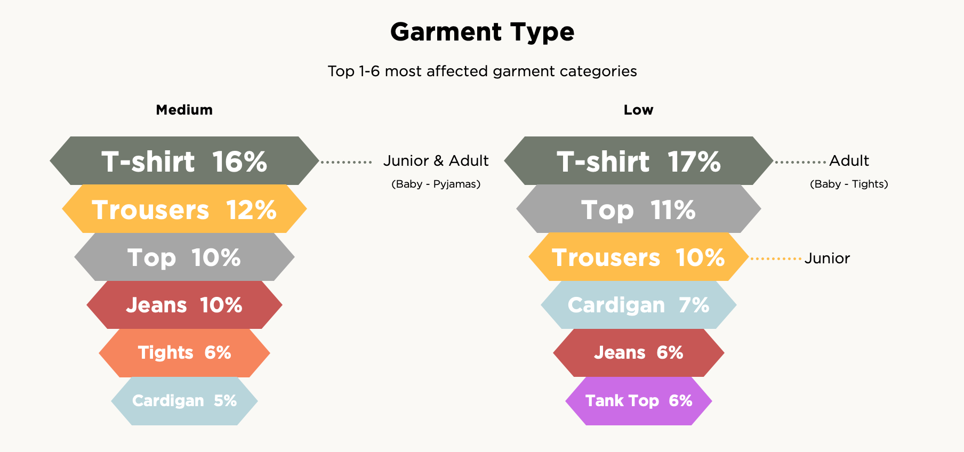
One of the most prominent trends in the analysis is that T-shirts feature heavily in both categories.
In the Medium category, T-shirts account for 16% of the clothing, followed by pants at 12%, tops at 10%, and jeans at 10%. In the Low category, T-shirts account for 17%, while tops account for 11% and pants for 10%.
Everyday clothing dominates in both categories. This also means that even small improvements in sorting can make a difference, because we’re dealing with large quantities of the same types of textiles.
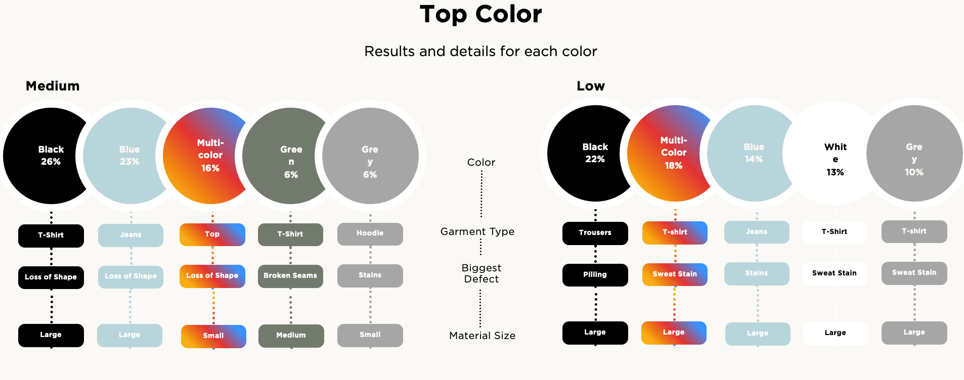
The colors provide a clear picture of the material. Black is the most dominant color. In one of the analyses, black textiles account for 26%, while blue accounts for 23% and multicolored textiles for 16%. The analysis also indicates that white and other light-colored textiles are more prevalent in the “Low” category. One possible explanation is that stains are simply more visible on light-colored textiles.
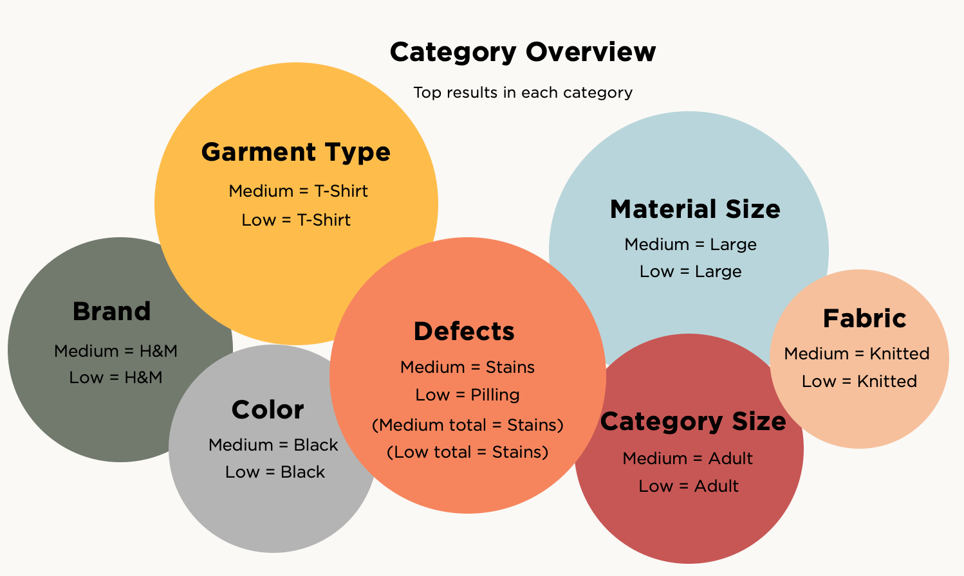
Looking at the overall results, H&M is the most prominent brand in both the Medium and Low categories. T-shirts, dark fabrics, oversized fits, adult-sized clothing, and knitwear are recurring key characteristics.
When you take a closer look at the defects, it becomes clear why the clothing is placed in the various categories. In the “Medium” category, stains are the most common defect, accounting for 24%. This is followed by loss of shape at 22% and pilling at 19%. Loose or pulled threads account for 11%, while damaged seams account for 7%.
In the "Low" category, the picture is a little different. Here, pilling is the most common defect, accounting for 28%. Sweat stains account for 23%, while other stains account for 22%.
Many of the reported defects involve issues that could potentially be addressed. A stain, for example, may be a matter of cleaning rather than poor quality. This means that sorting shouldn’t just be about determining whether the clothing is good or bad. It’s also about figuring out what it takes to give the clothing a second chance. The analysis concludes that many textiles with stains can potentially be resold if they are simply cleaned before being sent on for textile recycling.
The analysis of the collected textiles shows that there is much more to textile waste streams than just discarded clothing. Across all categories, certain patterns emerge: T-shirts, adult clothing, knitwear, and plus-size items make up a large portion, while black is the most common color, and H&M is the most prominent brand.
At the same time, the analysis shows that defects such as stains, pilling, and loss of shape play a significant role in how the textiles are categorized.
The interesting thing is that a “flaw” doesn’t necessarily mean the garment is unusable.
One of the key takeaways from the analysis is that the “Low” category should not necessarily be viewed as the final destination. “Low” has the greatest overall weight, but the materials may still have potential for reuse, upcycling, or resale and can support the circular economy. At the same time, the “Medium” category appears to have greater sales potential because the textiles generally have fewer defects and can therefore be sold more easily with minimal improvements.”
The results and conclusions of the analysis thus demonstrate how data and sample sorting can be used to make more rational decisions regarding textiles. Instead of automatically treating damaged clothing as waste, one can investigate whether it can be washed, repaired, sold, or used in an entirely different way.
Because perhaps a more circular economy isn’t just about getting better at reusing our clothes, but also about getting better at seeing the value in what we would otherwise consider “trash.” As consumers, we can extend the life of our clothes by giving them a new purpose—for example, a stained T-shirt can be used as a dust cloth, or a pair of old jeans can be sewn into a tote bag. In this way, we as consumers can help support the transition to a circular economy.
Textiles are classified according to their condition and the extent of wear and damage:
PREMIUM
Looks practically new. No visible wear and tear, all parts are intact, the zippers work, and the labels may still be intact.
HIGH-
Only minor wear, such as slight fading. The garment is fully functional.
MEDIUM
Has one or two minor flaws, such as a broken zipper, small holes, a missing button, or noticeably faded color.
LOW-
Has multiple or more extensive damage, such as large holes, heavy soiling, severe pilling, or missing parts that affect functionality.
VERY LOW-
: Clothing that, in its current condition, is considered to have very limited usability. This category was not included in this analysis, as the material was deemed to be in too poor a condition.
"Very Low" may include, for example:
Very Low – Wet/Moldy
Wet or moldy textiles, often as a result of moisture, improper handling, or exposure to moisture.
Very Low – Contaminated/Damaged
Textiles with, for example, oil or paint stains, heavy soiling, or extensive damage.