

What do we do with textiles that can no longer be sold or used directly? An analysis conducted as part of the SorTex project shows that the answer is not necessarily to recycle them into new textiles. There are several possible avenues—from remaking and upcycling to potential use in insulation, fillers, nonwovens, and other industrial products. However, these applications are not yet well established, and the demand for lower-quality materials remains a challenge in many places. The path from textile waste to a new application therefore depends on quality, sorting, processing, demand, and, not least, economics.

What do we do with textiles that can no longer be sold or used directly? An analysis conducted as part of the SorTex project shows that the answer is not necessarily to recycle them into new textiles. There are several possible avenues—fromremakingand upcycling to potential use in insulation, fillers, nonwovens, and other industrial products. However, these applications are not yet well established, and the demand for lower-quality materials remains a challenge in many places. The path from textile waste to a new application therefore depends on quality, sorting, processing, demand, and, not least, economics.
When a piece of clothing can no longer be worn, it's easy to think that it has reached the end of its useful life.
But perhaps this is precisely where another part of the story begins.
Because even if a textile can no longer be sold as clothing, that doesn’t necessarily mean the material is worthless. The key question, instead, is: What can the material be used for—and what needs to be done before it can be used?
The analysis is based on the results from Work Package 5, including sub-activities 5.3 and 5.4. The focus has been on examining the demand for lower-quality textiles as well as the pretreatment requirements associated with their further use. In addition, the analysis has focused on various business models and the economic conditions associated with the handling and further use of the textiles. The objective has been to examine the opportunities and prerequisites for creating value and ensuring the economically sustainable use of lower-quality textiles through various business models.
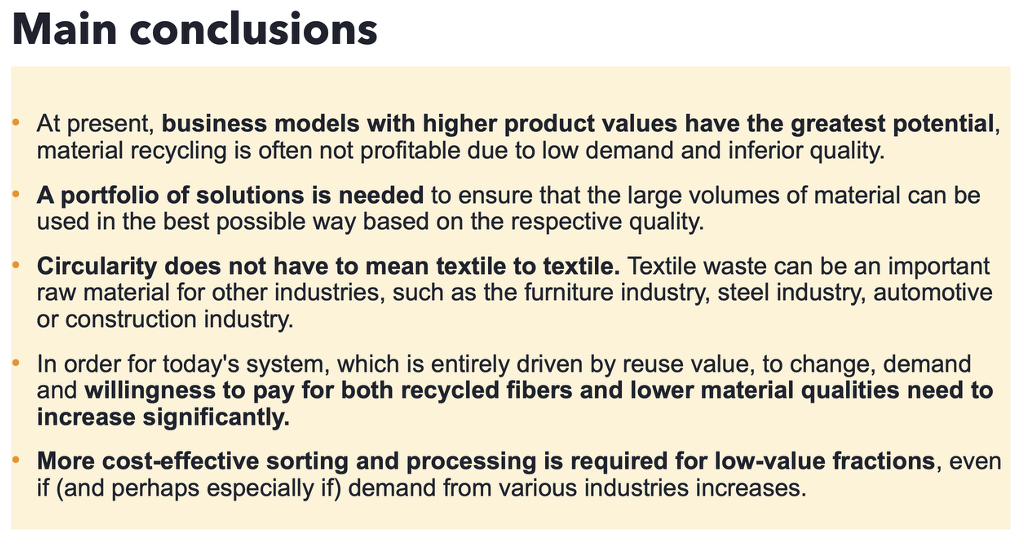
There is no single solution that works for all textiles.
A textile with high residual value may be cleaned, repaired, or upgraded and then resold. Another textile may be better suited for remaking or upcycling, in which the fabric is transformed into a new product. Other materials, after sorting and processing, can be used as raw materials for, for example, insulation, filling, or nonwoven materials.
However, not all textiles can be repurposed in a high-value way. Even when textiles are collected and sorted correctly, the condition, composition, and quality of the materials can limit the possibilities. At the same time, there must be a buyer who needs the material and is willing to pay a price that makes its use economically feasible.
That is why sorting is crucial—andthis applies even early in the value chain.
Pre-sorting helps determine which value streams are even possible.Iftextiles are identified and sorted from the outset based on, for example, quality, material type, condition, and potential uses, it becomes easier to direct them to the processing and applications that best suit their characteristics.
Conversely, inadequate sorting can mean that materials with real potential are mixed in with other fractions, making them more difficult or more expensive to utilize.
So it’s not just about finding a buyer for the textile waste. It’s also about creating the right conditions so that the materials can be identified, sorted, and matched with a relevant use.
One option is to preserve as much of the original fabric as possible.
This can be done, for example, through remaking or upcycling, where the clothing or fabric is given a new function without first being broken down into fibers. Larger textile surfaces can also be used to manufacture new products or materials.
In this case, the value isn't necessarily the fiber itself.
The value may lie in the fabric, the color, the pattern, the size, or the fact that the material already exists.
This also means that more precise sorting can make a difference. For example, if a company is looking for specific colors, materials, or fabric sizes, sorting based on the customer’s specific needs can be part of the business model.
However, this presupposes that there is genuine demand for the materials or products in question. The ability to manufacture a new product is not, in and of itself, a guarantee that it can be sold.
But not all textiles can be repurposed into a new product.
This is where other applications may come into play.
Textiles can potentially be used for insulation, fillers, and nonwoven products. They can also serve as raw materials in other industrial processes. The analysis highlights, among other things, potential applications in the furniture, automotive, construction, and other industries.
However, it is important to distinguish between technically feasible applications and established markets. Just because a textile material can be incorporated into a product does not necessarily mean that there is already sufficient demand, the necessary production capacity, or an economically viable business model. For several of these applications, it remains a challenge to achieve a stable balance between the materials’ properties, industry requirements, and consumers’ willingness to pay.
It also changes the way we think about the circular economy.
Circularity does not necessarily mean:
Old clothes --> new clothes.
It could also be:
Old clothes --> new material --> new use.
In this way, textile waste can become a raw material for an entirely different industry.
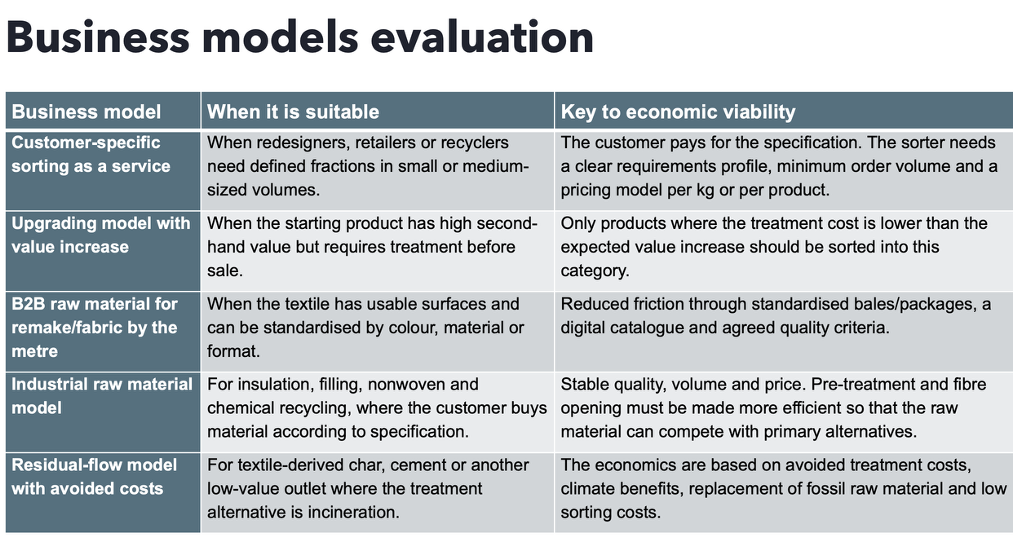
Although there are many technical options available, not all of them make economic sense. One of the challenges is that sorting and preprocessing can be expensive. Textiles must, among other things, be sorted, have hard parts removed, be cut, or be opened up into fibers before they can be used in new products. The analysis indicates that preprocessing can be a significant cost in the value chain.
At the same time, the willingness to pay for some of the lower-quality grades is limited. For example, the stated price levels for chemical recycling feedstock are significantly lower than the prices for several applications with higher material value (see the figure below). The figure thus shows how much a potential buyer is willing to pay for fibers/materials and, consequently, how much economic value different applications can have. In addition, there is also a comparison with “primary feedstock,” which refers to fibers/materials produced from new raw materials.
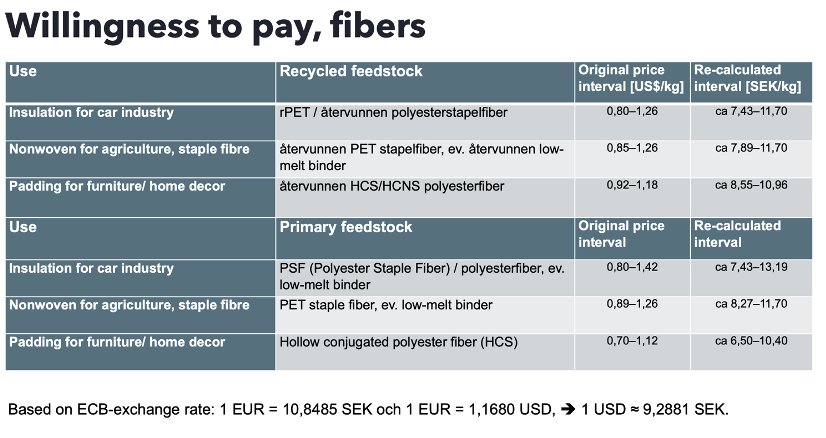
This means that it is not enough to ask:
Can we recycle the material?
One also has to ask:
Is it worth the effort to sort and process the material for that purpose?
If textiles are to move further up the value chain, this will require better sorting, relevant buyers, and demand for the materials.
Today, material recycling faces challenges such as limited demand, lower material quality, and the costs associated with sorting and pre-treatment. At the same time, the project shows that there are several potential applications if the materials can be sorted and processed in a way that meets the needs of the end users.
That is why the future of textile management may not just be about getting better at recycling textiles.
It’s also about getting better at identifying and sorting materials early on, understanding their true potential for use, and establishing connections between the textiles that are collected and the uses for which there is genuine demand.
However, not all textiles can necessarily be used at a high value level, even if they have been collected and sorted correctly. The goal is, of course, to place each textile at the highest possible value level where it is still technically and economically feasible.
However, the project also points out that this is not always possible. Therefore, solutions are needed across the entire value hierarchy—from secondhand goods and direct reuse at the high end, through various forms of remaking, upcycling, and material reuse, to those categories where energy recovery may ultimately be the most realistic solution.
Resale and Upgrading
Cleaning, repairs, or other minor improvements can prepare textiles for resale.
Remake and Upcycling
The fabric is used as material for a new product without first being broken down into fibers.
New Textile Material
Textiles can be broken down into fibers and used in new materials.
Insulation and Filling
Recycled fibers can be used for insulation, padding, and nonwoven products, among other things.
Industrial Applications
Textile materials can also serve as raw materials in other industries, such as the furniture, automotive, and construction industries.
Residual Fractions
In some cases, materials of very low value can be used, for example, in the cement industry or other processes, where the material replaces other raw materials or fuels.